
Imagine days so blessed that even the Prophet Muhammad ﷺ declared righteous deeds performed in them more beloved to Allah than any other time — including acts performed in the battlefield of Jihad. These are not ordinary days. They are the first ten days of Dhul Hijjah, the twelfth and final month of the Islamic Hijri calendar, known across the Muslim world also as Zil Hajj or Zul Hijjah.
Whether you are preparing for Hajj, planning to fast on the Day of Arafah, offering Qurbani, or simply seeking to draw closer to Allah ﷻ during these powerful days, this guide is your complete companion. We cover the meaning, the virtues, the key dates, and every major act of worship the Sunnah teaches us about this extraordinary month — all grounded in authenticated Quranic verses and Hadith.
What Is Dhul Hijjah? Understanding the 12th Month of the Islamic Calendar
Dhul Hijjah (Arabic: ذُو الْحِجَّةِ) literally means “the one with Hajj” or “the month of Hajj.” It is the twelfth and final month of the Islamic lunar (Hijri) calendar, following Dhul Qa’dah. In South Asian Muslim communities — Pakistan, India, Bangladesh — it is commonly called Zil Hajj or Zul Hijjah.
Because the Islamic calendar is lunar, Dhul Hijjah shifts approximately 10–11 days earlier each Gregorian year. This means the month falls in different seasons over the decades, cycling through all parts of the year approximately every 33 years.
Dhul Hijjah holds a unique position among all Islamic months for three reasons:
– It is one of the four sacred months in Islam (along with Dhul Qa’dah, Muharram, and Rajab)
– It contains the first ten days, which the Prophet ﷺ declared the holiest days of the entire year
– It is the month in which Hajj — the fifth pillar of Islam — takes place
Why Is Dhul Hijjah the Most Sacred Month in Islam?
What the Quran Says About Dhul Hijjah
Allah ﷻ Himself swears by the ten nights of Dhul Hijjah in the noble Quran — and an oath by Allah is the highest form of elevation:
Arabic: وَالْفَجْرِ وَلَيَالٍ عَشْرٍ
Transliteration: Wal-fajr, wa layālin ‘ashr
Translation: “By the dawn, and by the ten nights…”
— Surah Al-Fajr (89:1–2)
The overwhelming consensus of classical scholars — including Ibn Abbas (RA), Mujahid, and Imam Ibn Kathir — is that the “ten nights” in this oath refer specifically to the first ten days of Dhul Hijjah. Ibn Kathir states in his Tafsir: “The ten nights — what is intended by them are the ten nights of Dhul Hijjah, as stated by Ibn Abbas, Ibn Zubayr, Mujahid, and others.” [Tafsir Ibn Kathir, Surah Al-Fajr]
Allah ﷻ also refers to acts of worship during Dhul Hijjah in Surah Al-Hajj:
Arabic: وَيَذْكُرُوا اسْمَ اللَّهِ فِي أَيَّامٍ مَّعْلُومَاتٍ
Transliteration: Wa yadhkurusmallāhi fī ayyāmin ma’lūmāt
Translation: “…and mention the name of Allah on the appointed days…”
— Surah Al-Hajj (22:28)
Ibn Abbas (RA) explained that “appointed days” (ayyāmin ma’lūmāt) refers to the first ten days of Dhul Hijjah. [Tafsir Ibn Kathir, Surah Al-Hajj]
What the Hadith Says About Dhul Hijjah
The Prophetic traditions leave no ambiguity about the status of these days.
On the virtue of good deeds in the first ten days:
Ibn Abbas (RA) reported that the Prophet Muhammad ﷺ said:
Arabic: مَا مِنْ أَيَّامٍ الْعَمَلُ الصَّالِحُ فِيهَا أَحَبُّ إِلَى اللَّهِ مِنْ هَذِهِ الْأَيَّامِ
Transliteration: Mā min ayyāmin al-‘amalu aṣ-ṣāliḥu fīhā aḥabbu ilallāhi min hādhihil ayyām
Translation: “There are no days on which righteous deeds are more beloved to Allah than these ten days.”
The Companions asked: “Not even Jihad in the path of Allah?” He ﷺ replied: “Not even Jihad in the path of Allah — except for the man who goes out with his life and his wealth and does not return with either.”
— Sahih al-Bukhari, Hadith No. 969
This single Hadith establishes that the first ten days of Dhul Hijjah represent an unparalleled window of spiritual opportunity for every Muslim — not just those performing Hajj.
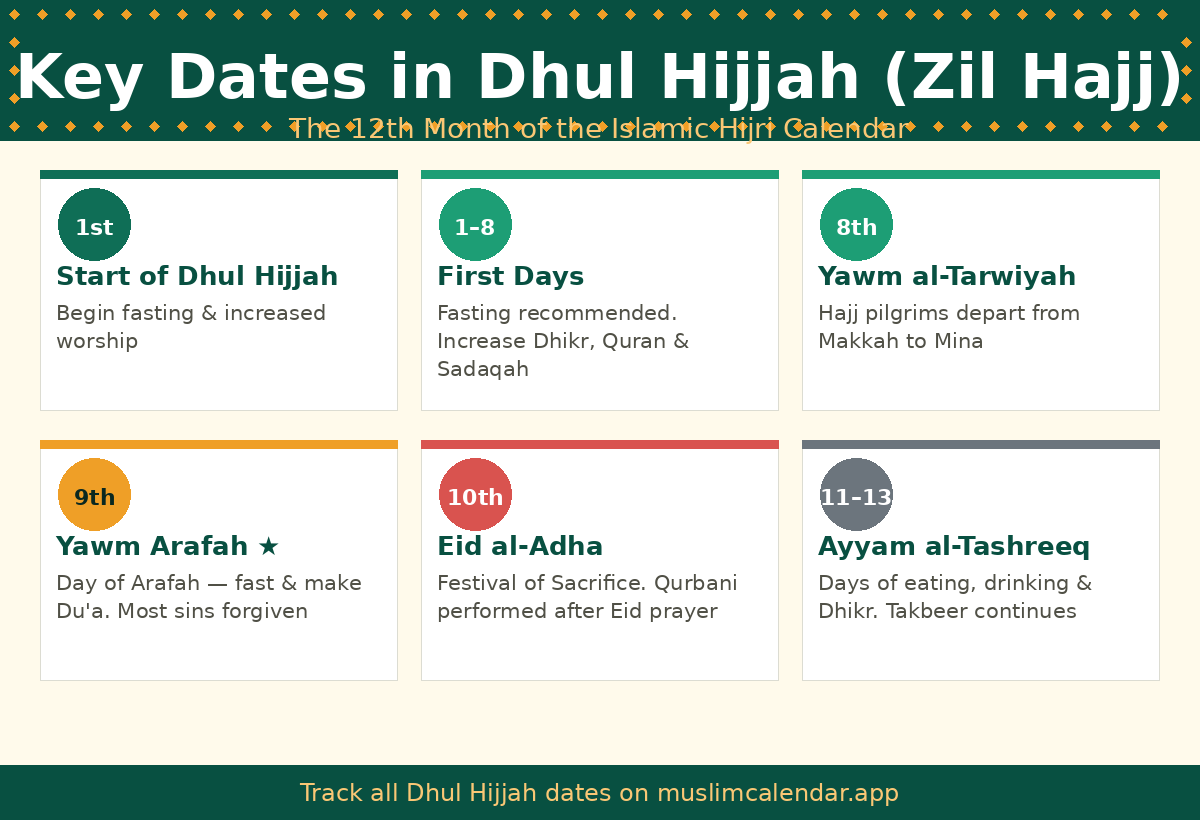
Key Dates in Dhul Hijjah You Must Know
| Date (Dhul Hijjah) | Event |
|---|---|
| 1st Dhul Hijjah | Beginning of the sacred month — fast & worship recommended |
| 1st–8th Dhul Hijjah | First days of Hajj preparations; fasting recommended |
| 8th Dhul Hijjah | Yawm al-Tarwiyah — Hajj pilgrims travel to Mina |
| 9th Dhul Hijjah | Yawm Arafah (Day of Arafah) — the pinnacle of Hajj; fasting for non-pilgrims |
| 10th Dhul Hijjah | Eid al-Adha — Festival of Sacrifice; Qurbani performed |
| 11th–13th Dhul Hijjah | Ayyam al-Tashreeq — days of eating, drinking, and Dhikr |
| 10th–13th Dhul Hijjah | Stoning of Jamarat in Makkah (Hajj rites) |
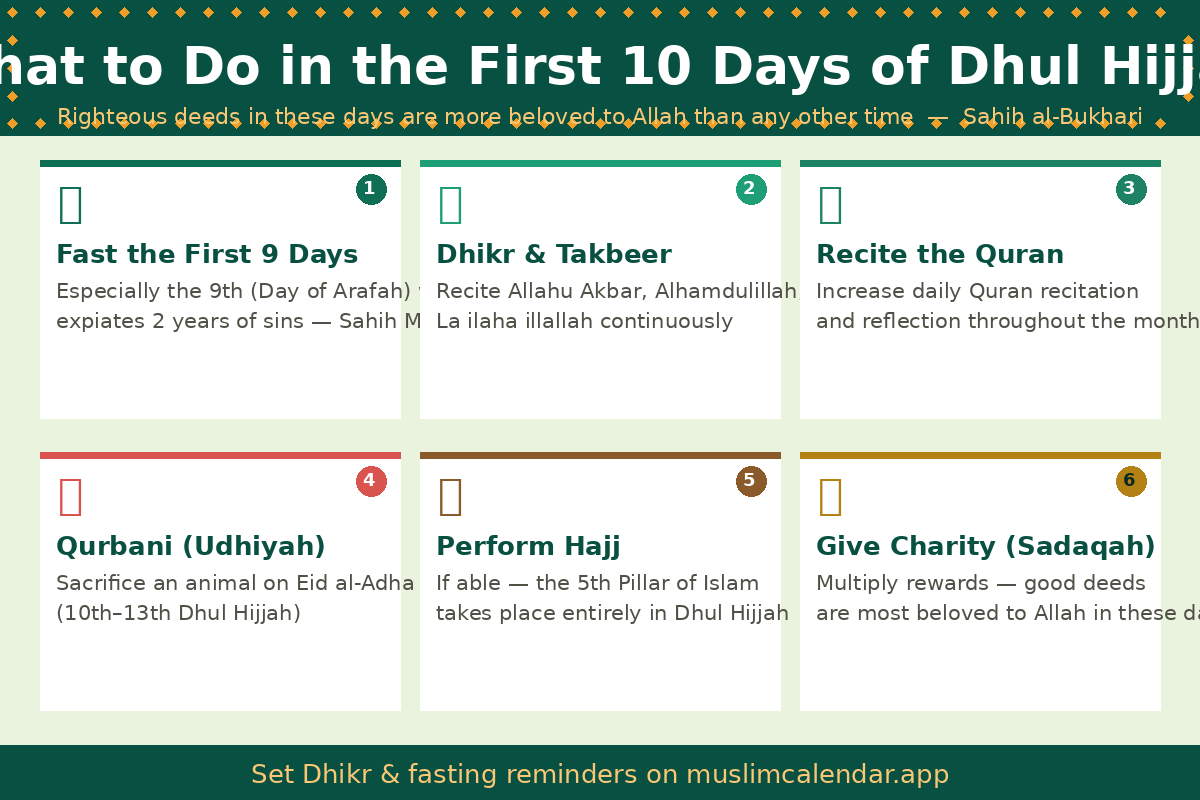
The First 10 Days of Dhul Hijjah: The Holiest Days of the Year
The first ten days of Dhul Hijjah are often called the “best ten days of the year.” While the last ten nights of Ramadan are the holiest nights, scholars such as Ibn al-Qayyim al-Jawziyyah have argued that the first ten days of Dhul Hijjah are the holiest days — because they combine the greatest pillars of worship: Salah, Sawm, Sadaqah, and Hajj.
Fasting in the First 9 Days of Dhul Hijjah
While fasting on Eid al-Adha (10th Dhul Hijjah) is forbidden (haram), fasting on any or all of the first nine days of Dhul Hijjah is highly recommended. The Prophet ﷺ himself used to fast these days:
Hafsah (RA) reported: “The Prophet ﷺ never abandoned four things: fasting the day of ‘Ashura, fasting the (first) ten (days of Dhul Hijjah), fasting three days of each month, and praying two Rak’ahs before Fajr.”
— Sunan al-Nasa’i, Hadith No. 2416; Musnad Ahmad — authenticated
The Day of Arafah — 9th Dhul Hijjah
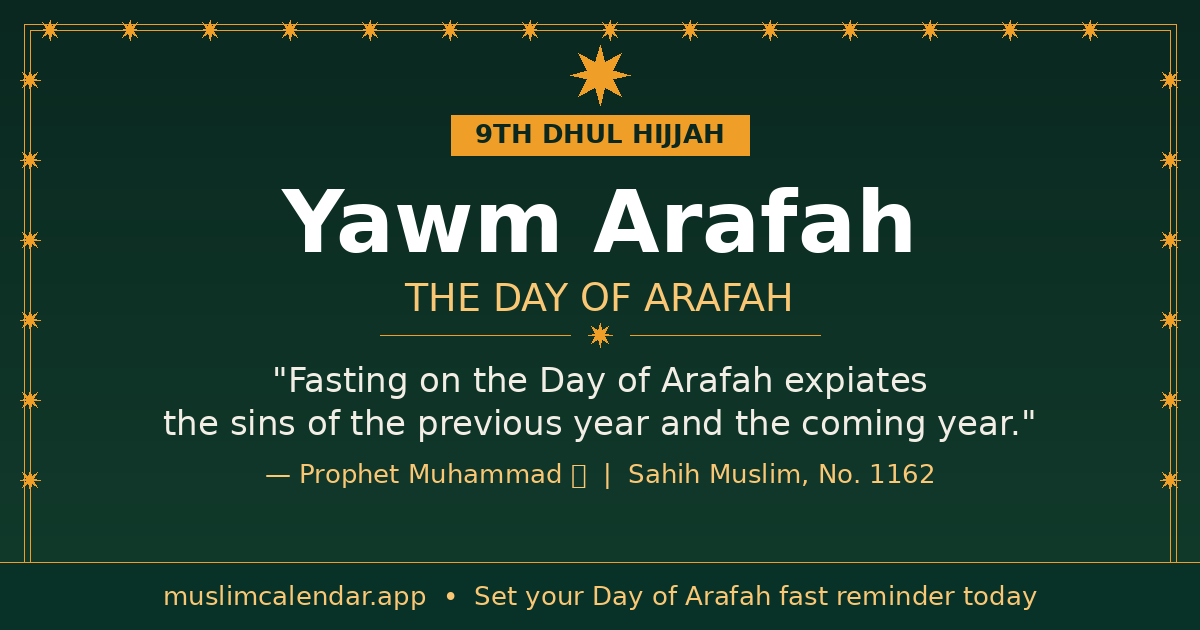
The 9th of Dhul Hijjah, known as Yawm Arafah (يَوْمُ عَرَفَة), is the single most important day of the Islamic year. For Hajj pilgrims, standing on the plains of Arafah is the very pillar (rukn) of Hajj — without it, the Hajj is invalid. For Muslims at home, it is a day of intense fasting, du’a, and tawbah (repentance).
The Prophet ﷺ said about fasting on this day:
Arabic: صِيَامُ يَوْمِ عَرَفَةَ أَحْتَسِبُ عَلَى اللَّهِ أَنْ يُكَفِّرَ السَّنَةَ الَّتِي قَبْلَهُ وَالسَّنَةَ الَّتِي بَعْدَهُ
Transliteration: Ṣiyāmu yawmi ‘Arafata aḥtasibu ‘alallāhi an yukaffira as-sanata allatī qablahu waas-sanata allatī ba’dahu
Translation: “Fasting on the Day of Arafah — I hope that Allah will expiate the sins of the year before it and the year after it.”
— Sahih Muslim, Hadith No. 1162 (Narrated by Abu Qatadah al-Ansari RA)
And on the Day of Arafah itself, Allah ﷻ boasts about His servants before His angels:
“There is no day on which Allah frees more of His servants from the Fire than the Day of Arafah. He draws close, then boasts about them before the angels, saying: ‘What do these people want?'”
— Sahih Muslim, Hadith No. 1348 (Narrated by Aisha RA)
Dhikr, Takbeer, and Tahmeed
One of the most emphasized acts of Dhul Hijjah is constant Dhikr — the remembrance of Allah — especially the Takbeer (اللّٰهُ أَكْبَر), Tahleel (لَا إِلٰهَ إِلَّا اللّٰهُ), and Tahmeed (الْحَمْدُ لِلّٰهِ).
Abdullah ibn Umar (RA) and Abu Hurairah (RA) would go to the marketplace during the first ten days of Dhul Hijjah and recite Takbeer aloud, until the people around them would also begin reciting. [Sahih al-Bukhari, Book of Eid — Mu’allaq narration, authenticated in practice]
The recommended Takbeer formula is:
اللّٰهُ أَكْبَرُ، اللّٰهُ أَكْبَرُ، لَا إِلٰهَ إِلَّا اللّٰهُ، وَاللّٰهُ أَكْبَرُ، اللّٰهُ أَكْبَرُ، وَلِلّٰهِ الْحَمْدُ
Allāhu Akbar, Allāhu Akbar, Lā ilāha illallāh, wallāhu Akbar, Allāhu Akbar, wa lillāhil ḥamd
“Allah is the Greatest, Allah is the Greatest, there is no god but Allah, and Allah is the Greatest, Allah is the Greatest, and to Allah belongs all praise.”
The Mursil Takbeer (continuous Takbeer) begins from the 1st of Dhul Hijjah and continues through all of Ayyam al-Tashreeq (13th Dhul Hijjah). The Muqayyad Takbeer (after each Fard prayer) begins after Fajr on the Day of Arafah (9th) and continues until Asr on the 13th of Dhul Hijjah.
Eid al-Adha: The Festival of Sacrifice (10th Dhul Hijjah)
The 10th of Dhul Hijjah marks Eid al-Adha (عِيدُ الْأَضْحَى) — the greater of the two Islamic Eids and, according to many scholars, the greater celebration in the Islamic year. Also known as Yawm al-Nahr (the Day of Slaughter), this day commemorates the magnificent trial of Prophet Ibrahim (AS), who was commanded by Allah to sacrifice his son Ismail (AS). As Ibrahim (AS) prepared to comply, Allah ﷻ ransomed Ismail with a great sacrifice — a moment immortalised in the Sunnah of Qurbani.
Qurbani (Udhiyah) — The Sunnah Sacrifice
Qurbani (Arabic: أُضْحِيَة, Udhiyah) — the ritual slaughter of an animal on Eid al-Adha — is one of the most loved acts of the day. The Prophet ﷺ said:
Arabic: مَا عَمِلَ آدَمِيٌّ مِنْ عَمَلٍ يَوْمَ النَّحْرِ أَحَبَّ إِلَى اللَّهِ مِنْ إِهْرَاقِ الدَّمِ
Transliteration: Mā ‘amila ādamiyyun min ‘amalin yawman-naḥri aḥabba ilallāhi min ihrāqid-dam
Translation: “There is no deed that a person does on the Day of Nahr (Eid al-Adha) that is more beloved to Allah than shedding the blood (of sacrifice).”
— Sunan al-Tirmidhi, Hadith No. 1493; Sunan Ibn Majah, Hadith No. 3126 (Narrated by Aisha RA — graded Hasan)
Who must perform Qurbani? According to the majority of scholars (Hanafi, Maliki, Hanbali), Udhiyah is wajib (obligatory) on every adult Muslim who possesses the nisab (minimum wealth threshold) and is not performing Hajj. According to the Shafi’i school, it is a confirmed Sunnah (Sunnah Mu’akkadah).
Animals eligible for Qurbani: Sheep or goat (1 animal = 1 household), cow or bull (1 animal = up to 7 households), camel (1 animal = up to 7 households).
When to slaughter: From after the Eid prayer on the 10th until sunset on the 13th of Dhul Hijjah (during the Days of Tashreeq).
The Days of Tashreeq (11th–13th Dhul Hijjah)
The 11th, 12th, and 13th of Dhul Hijjah are known as Ayyam al-Tashreeq (أَيَّامُ التَّشْرِيق). The Prophet ﷺ described these days:
“The days of Tashreeq are days of eating, drinking, and the remembrance of Allah.”
— Sahih Muslim, Hadith No. 1141 (Narrated by Nubayshah al-Hudhaliy RA)
Key points about Ayyam al-Tashreeq:
– Fasting is forbidden on these three days (alongside Eid al-Adha)
– Takbeer (Muqayyad) continues after every obligatory prayer until Asr on the 13th
– Qurbani can still be performed until sunset on the 13th
– For Hajj pilgrims: the stoning of Jamarat (Rami) takes place on all three days, and most pilgrims spend the nights in Mina
Hajj: The Fifth Pillar of Islam Takes Place in Dhul Hijjah
Dhul Hijjah is inseparable from Hajj — the fifth pillar of Islam. Allah ﷻ commands:
Arabic: وَلِلَّهِ عَلَى النَّاسِ حِجُّ الْبَيْتِ مَنِ اسْتَطَاعَ إِلَيْهِ سَبِيلًا
Transliteration: Wa lillāhi ‘alan-nāsi ḥijjul-bayti manistaṭā’a ilayhi sabīlā
Translation: “And [due] to Allah from the people is a pilgrimage to the House — for whoever is able to find thereto a way.”
— Surah Aal-Imran (3:97)
Hajj is obligatory once in a lifetime for every Muslim who is physically and financially capable. Its key rites unfold across Dhul Hijjah:
- 8th Dhul Hijjah (Yawm al-Tarwiyah): Pilgrims travel from Makkah to Mina and spend the day and night there in worship
- 9th Dhul Hijjah (Yawm Arafah): The standing at Arafah — the very heart of Hajj. The Prophet ﷺ said: “Hajj is Arafah.” [Sunan al-Tirmidhi, No. 889; Sunan Abu Dawud, No. 1949]
- Night of 9th–10th: Muzdalifah — pilgrims gather pebbles and pray Fajr there
- 10th Dhul Hijjah: Stoning the largest Jamarat, Qurbani, shaving the head (Halq/Taqsir), Tawaf al-Ifadah and Sa’i
- 11th–13th: Stoning of all three Jamarat, completing Hajj rites, Tawaf al-Wada (Farewell Tawaf)
How to Make the Most of Dhul Hijjah with the Muslim Calendar App
Tracking Dhul Hijjah dates accurately is critical — a single day’s difference can mean the difference between fasting on the correct Day of Arafah or missing it entirely. The Muslim Calendar App at muslimcalendar.app is built precisely for this:
- 📅 Accurate Hijri/Gregorian dual calendar view — see Dhul Hijjah dates mapped to Gregorian dates in real time
- 🔔 Reminders & Alerts — set notifications for the 1st of Dhul Hijjah, Day of Arafah, and Eid al-Adha
- 📿 Built-in Duas section — access authenticated Du’as for Dhul Hijjah, Hajj, and Eid al-Adha
- 📖 Quran access — read or listen to the Quran for your daily Dhul Hijjah recitation goal
- 🕌 Islamic event calendar — all major dates pre-loaded across the full Hijri year
- 📆 Appointment Booking — schedule your Qurbani, Eid prayers, and personal ibadah goals
Frequently Asked Questions About Dhul Hijjah
What is Dhul Hijjah in simple terms?
Dhul Hijjah (also called Zil Hajj or Zul Hijjah) is the 12th and final month of the Islamic lunar (Hijri) calendar. It is the month in which Hajj takes place and holds the holiest ten days of the year. It contains Eid al-Adha (10th) and the Days of Tashreeq (11th–13th).
Why is Dhul Hijjah so important in Islam?
Dhul Hijjah is one of Islam’s four sacred months and contains the first ten days which the Prophet ﷺ declared more beloved to Allah for good deeds than any other time — including Jihad (except for a martyr). It also contains the Day of Arafah, Eid al-Adha, Qurbani, and the pilgrimage of Hajj.
Can I fast during Dhul Hijjah?
Yes — fasting on any of the first 9 days of Dhul Hijjah is highly recommended. The most important fast is on the 9th (Day of Arafah), which the Prophet ﷺ said expiates two years of sins. Fasting is strictly forbidden on the 10th (Eid al-Adha) and the 11th–13th (Ayyam al-Tashreeq).
Is Qurbani (Udhiyah) obligatory in Dhul Hijjah?
Qurbani is obligatory (Wajib) according to the Hanafi, Maliki, and Hanbali schools for every adult Muslim who possesses the Nisab and is not performing Hajj. For the Shafi’i school, it is a confirmed Sunnah. It is performed from after Eid prayer on the 10th until sunset of the 13th of Dhul Hijjah.
What is the difference between Dhul Hijjah, Zil Hajj, and Zul Hijjah?
These are simply different transliterations and regional names for the same month. “Dhul Hijjah” is the classical Arabic transliteration. “Zil Hajj” is common in South Asia (Urdu/Bengali speakers), and “Zul Hijjah” is a variant spelling. They all refer to the 12th month of the Islamic Hijri calendar.
What special du’a should I recite in Dhul Hijjah?
Among the most recommended remembrances are: the Takbeer (Allahu Akbar), Tahleel (La ilaha illallah), Tahmeed (Alhamdulillah), and Tasbih (Subhanallah). Also, increase in Istighfar (seeking forgiveness), recitation of Surah Al-Kahf on Fridays, and making du’a on the Day of Arafah — particularly the du’a: “Lā ilāha illallāhu waḥdahu lā sharīka lah, lahul mulku wa lahul ḥamdu wa Huwa ‘alā kulli shay’in Qadīr” (reported as the best du’a of the Day of Arafah – Sunan al-Tirmidhi, Hadith No. 3585).
Conclusion: Make Dhul Hijjah Count
Dhul Hijjah is not just the final month of the Hijri calendar, it is Allah’s gift of an annual spiritual summit for every Muslim. Whether you are in Makkah completing the rites of Hajj, or at home fasting on the Day of Arafah, offering Qurbani, or simply saying “Allahu Akbar” with a sincere heart in a marketplace — these days hold a weight that no other time of year can match.
The Prophet ﷺ did not single out this month for scholars or pilgrims alone. He ﷺ addressed every believing man and woman: “There are no days in which righteous deeds are more beloved to Allah than these ten days.” That is an invitation extended to all of us.
Use the Muslim Calendar App to track every blessed day, set your ibadah reminders, access your Dhul Hijjah duas, and stay connected with the rhythm of the Islamic year – all in one place.
May Allah ﷻ accept from us and from you. Ameen.