
As Ramadan draws toward its final stretch, Muslims around the world enter the most spiritually powerful period of the month the last 10 nights of Ramadan.
These nights are a time when believers increase their worship, seek forgiveness, and search for Laylat al-Qadr (The Night of Decree) — a night that is better than a thousand months.
The Prophet Muhammad ﷺ treated these nights differently from the rest of Ramadan. Aisha (RA) reported:
“When the last ten nights of Ramadan began, the Messenger of Allah ﷺ would tighten his waist belt, spend the night in worship, and wake his family.”
— Sahih al-Bukhari (2024), Sahih Muslim (1174)
This shows that the last ten nights are not simply the end of Ramadan — they are the grand finale of the entire month.
Even if the earlier days of Ramadan were not perfect, these final nights offer an opportunity to finish strong.
Laylat al-Qadr: The Night Better Than 1,000 Months
The greatest blessing hidden within the last ten nights is Laylat al-Qadr.
Allah says in the Quran:
“The Night of Decree is better than a thousand months.”
— Surah Al-Qadr (97:3)
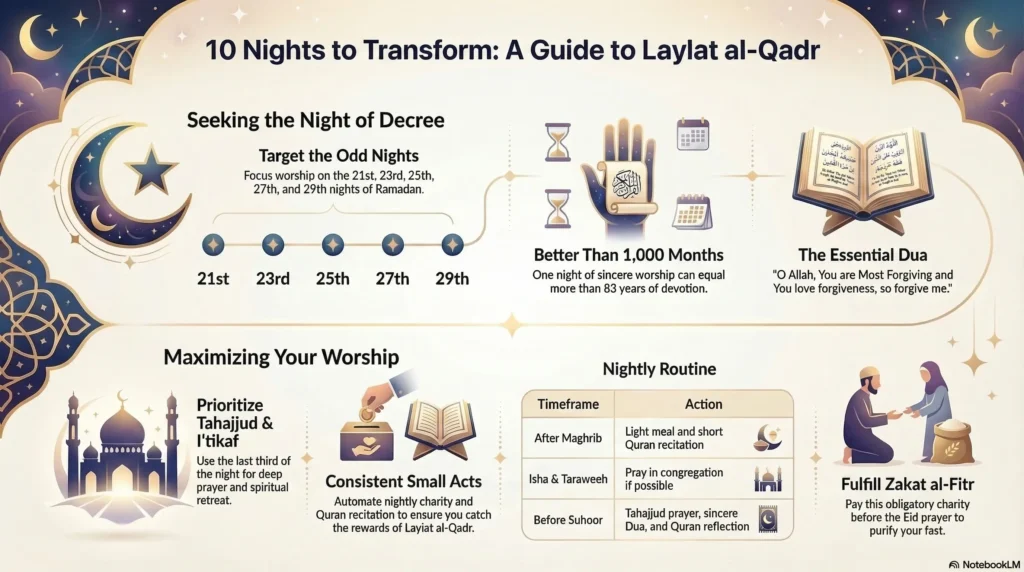
A thousand months equals more than 83 years of worship. This means that a single night of sincere prayer, charity, and remembrance of Allah could be rewarded more than a lifetime of devotion.
Because the exact night is hidden, Muslims are encouraged to search for it throughout the final ten nights.
The Prophet ﷺ said:
“Seek Laylat al-Qadr in the odd nights of the last ten nights of Ramadan.”
— Sahih al-Bukhari (2017)
These nights include:
- 21st night
- 23rd night
- 25th night
- 27th night
- 29th night
While many Muslims emphasize the 27th night, authentic narrations show that Laylat al-Qadr can occur on any of the odd nights.
This wisdom encourages believers to remain consistent in worship throughout the entire final period of Ramadan.
The Best Dua for Laylat al-Qadr
One of the most powerful supplications for these nights was taught directly by the Prophet ﷺ.
Aisha (RA) asked the Prophet what she should say if she found Laylat al-Qadr.
He replied:
اللهم إنك عفو تحب العفو فاعف عني
Allahumma innaka ‘afuwwun tuhibbul ‘afwa fa’fu ‘anni
Meaning:
“O Allah, You are Most Forgiving and You love forgiveness, so forgive me.”
— Sunan al-Tirmidhi (3513)
This simple dua perfectly captures the spirit of Ramadan — seeking Allah’s mercy, forgiveness, and guidance.
Staying Focused During the last 10 nights of Ramadan
The final nights of Ramadan can be intense. Sleep schedules change, nights become longer, and it can be difficult to keep track of prayer times and important nights.
Many Muslims use tools that help them stay organized and focused during these nights.
The Muslim Calendar App helps by providing:
- Accurate prayer times based on your location
- Clear Hijri and Gregorian calendar view
- Odd-night reminders for Laylat al-Qadr
- Gentle Tahajjud alerts
- A clean ad-free experience designed for worship
Instead of constantly checking multiple sources, everything needed for Ramadan worship can be kept in one place.
I’tikaf: The Spiritual Retreat of the Last Ten Nights
Another beautiful Sunnah of the last ten nights is I’tikaf.
I’tikaf is a spiritual retreat where a Muslim stays in the mosque to dedicate their time completely to worship, Quran recitation, and reflection.
Ibn Umar (RA) reported:
“The Messenger of Allah ﷺ used to observe I’tikaf in the last ten nights of Ramadan.”
— Sahih al-Bukhari (2026)
During I’tikaf, a believer minimizes worldly distractions and focuses entirely on strengthening their relationship with Allah.
For those who cannot stay in the mosque due to family or work responsibilities, it is still possible to create a personal worship retreat at home by reducing distractions and dedicating time each night to prayer and reflection.
Tahajjud: The Most Powerful Prayer of the Night
One of the most powerful acts of worship during the last ten nights is Tahajjud, the voluntary night prayer.
The Prophet ﷺ said:
“Our Lord descends to the lowest heaven during the last third of the night and says: Who is calling upon Me so that I may answer him?”
— Sahih al-Bukhari (1145), Sahih Muslim (758)
This moment — the final third of the night — is considered one of the most powerful times to make dua.
However, many people struggle to calculate the exact time for Tahajjud.
Using a companion tool like the Muslim Calendar App can help by:
- Showing the exact last third of the night
- Sending quiet Tahajjud reminders
- Providing Qibla direction anywhere
- Displaying the current Ramadan night
This allows worshippers to focus more on prayer and less on logistics.
Small Acts With Huge Rewards
During the last ten nights, even small actions can carry tremendous reward.
Some simple acts include:
Giving charity every night
If you give charity each night and one of those nights is Laylat al-Qadr, the reward could equal decades of charity.
Reciting Quran
Even a few verses recited with reflection can bring great blessings.
Making sincere dua
These nights are among the best times to ask Allah for guidance, forgiveness, and mercy.
Seeking forgiveness
Frequent Istighfar softens the heart and strengthens faith.
Zakat al-Fitr: An Obligation Before Eid
As Ramadan concludes, Muslims must fulfill Zakat al-Fitr, a mandatory charity given before Eid prayer.
Ibn Umar (RA) reported:
“The Messenger of Allah ﷺ made Zakat al-Fitr obligatory on every Muslim, young or old, male or female.”
— Sahih al-Bukhari (1503)
Zakat al-Fitr serves two important purposes:
- It purifies the fasting person from mistakes made during Ramadan.
- It ensures that those in need can celebrate Eid with dignity.
Traditionally it equals approximately 2.5–3 kg of staple food, such as wheat, rice, or dates.
It must be given before the Eid prayer.
A Simple Routine for the Last 10 Nights
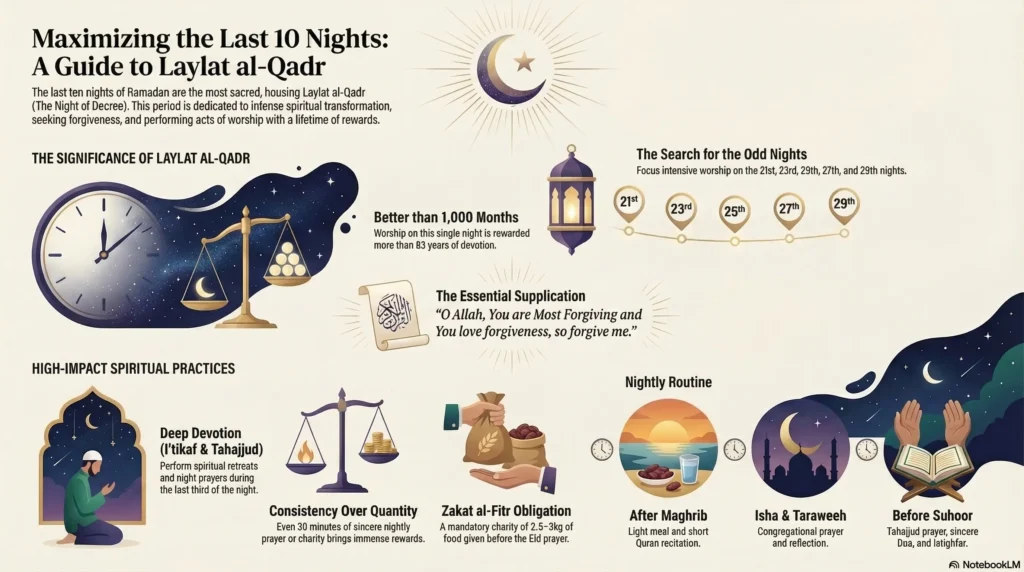
A simple nightly routine can help maintain consistency during the final stretch of Ramadan.
After Maghrib
Light meal and Quran recitation.
Isha and Taraweeh
Pray in congregation if possible.
After Taraweeh
Rest or take a short nap.
Before Suhoor
Wake up for Tahajjud, make dua, and recite Quran.
Consistency matters more than quantity. Even 20–30 minutes of sincere worship every night can have a powerful impact.
Make the Most of Ramadan With the Muslim Calendar App
The last ten nights of Ramadan are precious, and distractions can easily reduce the time we dedicate to worship.
The Muslim Calendar App was designed to help Muslims stay organized and spiritually focused during Ramadan and throughout the year.
Features include:
- Accurate global prayer times
- Hijri calendar tracking
- Laylat al-Qadr reminders
- Ramadan dua guidance
- Quiet notifications designed for worship
Whether you are searching for Laylat al-Qadr or simply trying to maintain consistency in your prayers, the app serves as a simple companion for daily worship.
Preparing for Eid al-Fitr
As Ramadan ends, Muslims look forward to the celebration of Eid al-Fitr.
Some Sunnah practices include:
- Performing Ghusl before Eid prayer
- Wearing clean or new clothes
- Eating dates before the prayer
- Greeting others and spreading joy
But the spirit of Ramadan does not end with Eid.
The Prophet ﷺ said:
“Whoever fasts Ramadan and follows it with six days of Shawwal, it is as if he fasted the entire year.”
— Sahih Muslim (1164)
Download The App Now


Frequently Asked Questions About the Last 10 Nights of Ramadan
What are the last 10 nights of Ramadan?
The last 10 nights of Ramadan are considered the most spiritually significant nights of the month. During this time, Muslims increase acts of worship such as prayer, Quran recitation, charity, and remembrance of Allah while searching for Laylat al-Qadr (The Night of Decree).
When do the last 10 nights of Ramadan start?
The last ten nights begin on the 21st night of Ramadan and continue until the end of the month. Since the Islamic calendar follows the lunar cycle, the exact dates vary each year depending on moon sightings.
Which night is Laylat al-Qadr?
Laylat al-Qadr occurs during the last ten nights of Ramadan, most likely on one of the odd nights:
- 21st night
- 23rd night
- 25th night
- 27th night
- 29th night
Many Muslims emphasize the 27th night, but authentic hadith indicate that the exact night is hidden so believers remain consistent in worship.
What is the best dua for Laylat al-Qadr?
The best dua for Laylat al-Qadr is the supplication taught by the Prophet Muhammad ﷺ:
Allahumma innaka ‘afuwwun tuhibbul ‘afwa fa’fu ‘anni
Meaning:
“O Allah, You are Most Forgiving and You love forgiveness, so forgive me.”
— Sunan al-Tirmidhi (3513)
What should Muslims do during the last 10 nights of Ramadan?
Muslims increase their worship during these nights by:
- Performing Tahajjud (night prayer)
- Reciting Quran
- Making dua
- Giving charity
- Engaging in dhikr (remembrance of Allah)
- Performing I’tikaf in the mosque if possible
These acts help believers maximize the spiritual rewards of the final nights of Ramadan.
What is I’tikaf in Ramadan?
I’tikaf is a spiritual retreat performed in the mosque during the last ten days of Ramadan. A Muslim dedicates their time entirely to worship, prayer, Quran recitation, and reflection while minimizing worldly distractions.
The Prophet ﷺ regularly observed I’tikaf during these nights.
When should Zakat al-Fitr be paid?
Zakat al-Fitr must be paid before the Eid prayer. It can be given during the last days of Ramadan to ensure that those in need can celebrate Eid with dignity.
How can I keep track of the last 10 nights of Ramadan?
Many Muslims use Islamic tools or apps to help track prayer times, Ramadan nights, and Laylat al-Qadr reminders. Tools like the Muslim Calendar App can help by providing accurate prayer timings, Hijri dates, and alerts for important nights during Ramadan.
Final Thought
The last ten nights of Ramadan are a gift from Allah — a chance to seek forgiveness, strengthen faith, and transform our lives.
Even if the beginning of Ramadan was difficult, these nights offer a new opportunity to reconnect with Allah.
May Allah accept our prayers, forgive our sins, and allow us to witness the blessings of Laylat al-Qadr.
Ameen.
<script type="application/ld+json">
{
"@context": "https://schema.org",
"@graph": [

{
"@type": "Organization",
"@id": "https://muslimcalendar.app/#organization",
"name": "Muslim Calendar",
"url": "https://muslimcalendar.app/",
"logo": {
"@type": "ImageObject",
"url": "https://muslimcalendar.app/wp-content/uploads/2025/06/678-scaled.webp"
},
"sameAs": [
"https://twitter.com/",
"https://facebook.com/",
"https://instagram.com/"
]
},

{
"@type": "Person",
"@id": "https://muslimcalendar.app/#author",
"name": "Muslim Calendar Editorial Team",
"url": "https://muslimcalendar.app/",
"affiliation": {
"@id": "https://muslimcalendar.app/#organization"
}
},

{
"@type": "ImageObject",
"@id": "https://muslimcalendar.app/blog/last-10-nights-ramadan/#featuredimage",
"url": "https://muslimcalendar.app/images/last-10-nights-ramadan.jpg",
"width": 1200,
"height": 630
},

{
"@type": "WebPage",
"@id": "https://muslimcalendar.app/blog/last-10-nights-ramadan/#webpage",
"url": "https://muslimcalendar.app/blog/last-10-nights-ramadan/",
"name": "The Last 10 Nights of Ramadan: How to Maximize Laylat al-Qadr",
"isPartOf": {
"@id": "https://muslimcalendar.app/#website"
},
"primaryImageOfPage": {
"@id": "https://muslimcalendar.app/blog/last-10-nights-ramadan/#featuredimage"
},
"datePublished": "2026-03-01",
"dateModified": "2026-03-01",
"inLanguage": "en"
},

{
"@type": "BlogPosting",
"headline": "The Last 10 Nights of Ramadan: How to Maximize Laylat al-Qadr",
"description": "A complete guide to the last 10 nights of Ramadan including Laylat al-Qadr, powerful duas, Tahajjud worship, i'tikaf, and Zakat al-Fitr with authentic Hadith references.",
"author": {
"@id": "https://muslimcalendar.app/#author"
},
"publisher": {
"@id": "https://muslimcalendar.app/#organization"
},
"mainEntityOfPage": {
"@id": "https://muslimcalendar.app/blog/last-10-nights-ramadan/#webpage"
},
"image": {
"@id": "https://muslimcalendar.app/blog/last-10-nights-ramadan/#featuredimage"
},
"datePublished": "2026-03-01",
"dateModified": "2026-03-01",
"wordCount": "2200",
"articleSection": "Ramadan",
"keywords": [
"last 10 nights of Ramadan",
"Laylat al-Qadr",
"Ramadan worship guide",
"dua for Laylatul Qadr",
"Tahajjud in Ramadan",
"i'tikaf last ten nights"
]
},

{
"@type": "BreadcrumbList",
"itemListElement": [
{
"@type": "ListItem",
"position": 1,
"name": "Home",
"item": "https://muslimcalendar.app/"
},
{
"@type": "ListItem",
"position": 2,
"name": "Blog",
"item": "https://muslimcalendar.app/blog/"
},
{
"@type": "ListItem",
"position": 3,
"name": "Last 10 Nights of Ramadan",
"item": "https://muslimcalendar.app/blog/last-10-nights-ramadan/"
}
]
},

{
"@type": "FAQPage",
"mainEntity": [
{
"@type": "Question",
"name": "What are the last 10 nights of Ramadan?",
"acceptedAnswer": {
"@type": "Answer",
"text": "The last 10 nights of Ramadan are the most spiritually significant nights of the month when Muslims increase worship and search for Laylat al-Qadr."
}
},
{
"@type": "Question",
"name": "Which night is Laylat al-Qadr?",
"acceptedAnswer": {
"@type": "Answer",
"text": "Laylat al-Qadr occurs during the last ten nights of Ramadan, most likely on one of the odd nights such as the 21st, 23rd, 25th, 27th, or 29th night."
}
},
{
"@type": "Question",
"name": "What is the best dua for Laylat al-Qadr?",
"acceptedAnswer": {
"@type": "Answer",
"text": "The best dua is: Allahumma innaka 'afuwwun tuhibbul 'afwa fa'fu 'anni, meaning O Allah You are Most Forgiving and You love forgiveness so forgive me."
}
},
{
"@type": "Question",
"name": "What should Muslims do during the last 10 nights of Ramadan?",
"acceptedAnswer": {
"@type": "Answer",
"text": "Muslims increase acts of worship such as Tahajjud prayer, Quran recitation, charity, dhikr, dua, and i'tikaf during the final nights of Ramadan."
}
}
]
},

{
"@type": "MobileApplication",
"name": "Muslim Calendar App",
"operatingSystem": "Android, iOS",
"applicationCategory": "LifestyleApplication",
"url": "https://muslimcalendar.app/",
"description": "Muslim Calendar App helps Muslims track prayer times, Hijri dates, Ramadan nights, Laylat al-Qadr reminders, and daily Islamic events.",
"offers": {
"@type": "Offer",
"price": "0",
"priceCurrency": "USD"
}
}

]
}
</script>
Read From Our Other Blogs
Knowledge Base:
- Yaqeen : https://yaqeeninstitute.org/
- Muslim World League – https://themwl.org/